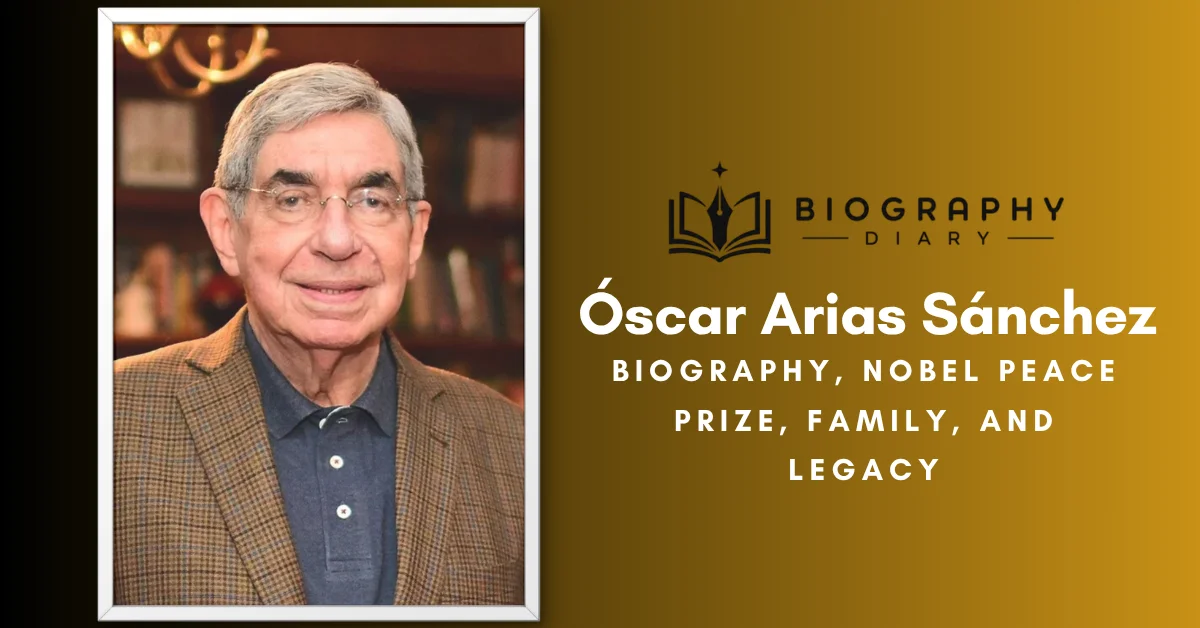
Óscar Arias Sánchez served twice as President of Costa Rica and became the country’s only Nobel Peace Prize laureate, honored in 1987 for engineering a peace plan that helped end a decade of civil wars across Central America. Nearly four decades later, he remains one of the most internationally recognized statesmen Costa Rica has ever produced.
Óscar Arias Sánchez: Quick Facts
| Full Name | Óscar Arias Sánchez |
| Date of Birth | September 13, 1940 (some sources cite 1941) |
| Age | 85 (as of 2026) |
| Place of Birth | Heredia, Costa Rica |
| Nationality | Costa Rican |
| Profession | Politician, Economist, Diplomat |
| Spouse | Margarita Penón Góngora (married. 1973; divorced.); Suzanne Fischel Kopper (married. 2012) |
| Children | Two — Silvia Eugenia and Óscar Felipe |
| Years Active | 1970 – present (public service) |
| Education | University of Costa Rica (Law); Ph.D. in Political Science, University of Sussex; further study at Harvard University and the London School of Economics |
| Notable For | President of Costa Rica (1986–1990, 2006–2010); 1987 Nobel Peace Prize laureate |
Quick Answer
Óscar Arias Sánchez is a Costa Rican politician who served two non-consecutive terms as President of Costa Rica (1986–1990 and 2006–2010) and won the 1987 Nobel Peace Prize for authoring the Esquipulas II peace accord, which helped end the region’s civil wars. He remains the only Costa Rican to have won a Nobel Prize.
| Name | Quick Fact | Why He Matters |
|---|---|---|
| Óscar Arias Sánchez | 1987 Nobel Peace Prize | Costa Rica’s only Nobel laureate and two-time president |
Early Life
Óscar Arias Sánchez was born on September 13 — sources differ between 1940 and 1941 — in Heredia, Costa Rica, into one of the country’s most prominent families. His father, Juan Rafael Arias Trejos, descended from a line of legislators and government ministers and later headed the Costa Rican Central Bank; both of Arias’s grandfathers were also prominent legislators.
His mother, Lillian Sánchez, was the daughter of one of Costa Rica’s wealthiest coffee plantation owners. The oldest of three children, Arias suffered from asthma as a boy and was raised in Heredia, near the capital, San José, in Costa Rica’s central plateau.
Education
Arias earned degrees in law and economics from the University of Costa Rica before pursuing graduate studies in Europe. He studied political science at the London School of Economics and went on to earn a Ph.D. in political science from the University of Essex in England. Over the course of his career, he has received approximately 50 honorary doctorates from universities across the world, including Harvard University.
Career Beginnings
Arias joined Costa Rica’s National Liberation Party (PLN) as a student and became active in its work throughout the 1960s. After returning to Costa Rica in 1969, he joined the faculty of the University of Costa Rica as a professor of political science while continuing his political involvement.
He began his formal political career in 1970 as national director of economic planning under President José “Pepe” Figueres, the leader renowned for abolishing Costa Rica’s army in 1948. In 1972, at age 30, Arias was appointed Minister of National Planning and Political Economy, a role in which he became known for legislation aimed at making government more accessible and responsive to ordinary citizens.
During this period, he also wrote extensively on Costa Rican politics and economics, publishing half a dozen books and numerous essays that helped establish him as a serious policy thinker well before he sought elected office himself.
Career Milestones
Arias was considered something of an upstart within his own party when he won the National Liberation Party’s presidential nomination, but he went on to win the presidency in February 1986, becoming one of Costa Rica’s youngest-ever leaders. As president, Arias inherited a region gripped by conflict, with a bitter civil war raging in neighboring Nicaragua and Cold War tensions playing out across Central America.
Rather than aligning fully with U.S. policy in the region, Arias pursued an independent path toward regional peace. In May 1986, he met with the presidents of Guatemala, El Salvador, Honduras, and Nicaragua to discuss existing peace proposals from the Contadora Group, though they failed to reach full agreement.
In early 1987, Arias called a new summit and submitted his own peace plan, departing in key respects from the earlier Contadora framework. The resulting accord — approved by the five Central American presidents in Guatemala on August 7, 1987, and known as Esquipulas II — called for free elections, protections for human rights, and an end to foreign intervention in the region’s internal conflicts.
For this achievement, Arias was awarded the Nobel Peace Prize on October 13, 1987, with the Nobel Committee commending him for an “outstanding contribution to the possible return of stability and peace to a region long torn by strife and civil war.” News of the award reached Arias while he was vacationing with his family at a beach in Guanacaste, roughly 130 miles from San José.
He used the prize money to establish the Arias Foundation for Peace and Human Progress in 1988, which went on to run three programs: the Center for Human Progress, focused on equal opportunities for women; the Center for Organized Participation, supporting philanthropy across Latin America; and the Center for Peace and Reconciliation, working on demilitarization and conflict resolution.
Arias returned to the presidency in 2006 after Costa Rica’s constitution was amended to permit non-consecutive re-election, narrowly winning the election against opposition candidate Ottón Solís. During his second term (2006–2010), he focused on expanding investment in education and housing and signed the Central America–Dominican Republic Free Trade Agreement (CAFTA-DR) with the United States, a move that was politically contentious within Costa Rica.

Óscar Arias Sánchez: Life & Career
1940
Born in Heredia, Costa Rica, into a prominent coffee-growing family.
1967
Law & Economics degrees (Univ. of Costa Rica); later Ph.D. in Political Science, Univ. of Essex.
1972
Appointed Minister of National Planning at age 31.
1986
Elected President of Costa Rica — first term.
Aug 1987
Esquipulas II Peace Accord signed by five Central American presidents.
Oct 1987
Awarded the Nobel Peace Prize — Costa Rica’s only laureate.
1988
Founded the Arias Foundation for Peace and Human Progress.
1990
First presidential term ends.
2006
Elected to a second term after constitutional amendment.
2007
CAFTA-DR free trade agreement approved via national referendum.
2010
Second term ends — continues global advocacy for peace & democracy.
Achievements
- Nobel Peace Prize, 1987, for authoring the Esquipulas II Central American peace accord
- President of Costa Rica, twice (1986–1990 and 2006–2010)
- Founder of the Arias Foundation for Peace and Human Progress (1988)
- Martin Luther King Peace Award, 1987
- Albert Schweitzer Humanitarian Award, 1988
- Co-recipient, Liberty Medal of Philadelphia, 1991
- Approximately 50 honorary doctorates from institutions worldwide
- Signed the CAFTA-DR free trade agreement with the United States during his second presidency
Personal Life
Arias married Margarita Penón Góngora in 1973; the couple had two children together, Silvia Eugenia and Óscar Felipe, before divorcing. He later married Suzanne Fischel Kopper in 2012. His children have largely stayed out of the public eye relative to Arias’s own high-profile political career, and Arias has continued to describe his upbringing in a politically engaged, coffee-growing family as foundational to his lifelong interest in public service and diplomacy.
Philanthropy
Beyond founding the Arias Foundation for Peace and Human Progress, Arias has remained active on the international stage well beyond his two presidencies. He has served on the Board of the InterAction Council, the International Negotiation Network of the Carter Center, and the Peres Center for Peace, among other international bodies focused on conflict resolution, disarmament, and democratic governance.
He has continued to travel and speak internationally on issues of democracy, disarmament, and free trade, extending the influence of his Nobel-winning peace work well into the 21st century. Through the Arias Foundation, he has also been a vocal advocate for reducing global military spending, arguing that resources devoted to arms purchases in developing nations would be better directed toward education, healthcare, and poverty reduction — a theme that has run consistently through his public speaking engagements since leaving office.

Controversies
Arias’s most significant point of domestic controversy came during his second presidency, when his decision to pursue and sign the CAFTA-DR free trade agreement with the United States divided Costa Rican public opinion, prompting a rare national referendum on the treaty in October 2007, which Arias’s side narrowly won.
Outside of these policy disputes, there is no substantiated record of personal scandal attached to Arias; his public reputation across more than five decades has remained centered on his peace-brokering and economic policy work rather than personal controversy.
Related: Famous Celebrities in Costa Rica: The Complete List
Influence and Legacy Snapshot
| Category | Contribution |
|---|---|
| Nobel Recognition | Costa Rica’s only Nobel Peace Prize laureate, awarded in 1987 |
| Regional Peacemaker | Authored the Esquipulas II accord that helped end Central America’s civil wars |
| National Leadership | Twice elected President of Costa Rica, in 1986 and 2006 |
| Philanthropy | Founder of the Arias Foundation for Peace and Human Progress |
| International Diplomacy | Continued global advocacy for democracy, disarmament, and conflict resolution after leaving office |
Legacy
Óscar Arias Sánchez’s Esquipulas II peace plan is widely credited by historians with helping end the region’s Cold War-era civil conflicts and setting Central America on a path toward greater democratic stability, even though the accord itself was never fully implemented in every signatory country.
As Costa Rica’s only Nobel laureate, Arias occupies a unique place in the nation’s history, frequently invoked as proof of the country’s outsized role in international diplomacy relative to its small size. His post-presidential work through the Arias Foundation has extended his influence into ongoing debates about disarmament, gender equity, and philanthropy across Latin America.

Arias is also frequently cited in political science literature as a case study in “middle power” diplomacy — demonstrating how a small nation without a standing army could still broker peace among larger, more heavily armed neighbors through sustained, patient negotiation rather than military leverage.
That legacy has shaped how Costa Rica presents itself internationally in the decades since, reinforcing the country’s long-standing self-image as a nation of peace, education, and diplomacy rather than military strength.
Conclusion
From a childhood in a politically connected coffee-growing family to authoring one of the defining peace accords of the Cold War era in Central America, Óscar Arias Sánchez’s career reflects a rare combination of intellectual rigor and practical diplomacy.
His two presidencies and his continued international advocacy through the Arias Foundation have cemented his standing as Costa Rica’s most internationally decorated statesman, and his name remains inseparable from the country’s national identity as a champion of peace over military strength.
Next In Your Reading: Franklin Chang Díaz: Biography, NASA Career, Family, and Legacy
Frequently Asked Questions
Why did Óscar Arias Sánchez win the Nobel Peace Prize?
He won the 1987 Nobel Peace Prize for authoring the Esquipulas II peace accord, a plan signed by five Central American presidents that aimed to end the region’s civil wars through free elections, human rights protections, and an end to foreign intervention.
How many times was Óscar Arias Sánchez president of Costa Rica?
Twice — from 1986 to 1990, and again from 2006 to 2010, after a constitutional amendment allowed non-consecutive re-election.
What did Óscar Arias Sánchez do with his Nobel Prize money?
He used it to establish the Arias Foundation for Peace and Human Progress in 1988, which supports programs focused on gender equity, philanthropy, and demilitarization across Latin America.
Is Óscar Arias Sánchez Costa Rica’s only Nobel Prize winner?
Yes. He remains the only Costa Rican to have won a Nobel Prize in any category.
What controversial policy did Arias pursue in his second term?
He championed the CAFTA-DR free trade agreement with the United States, which was put to a national referendum in Costa Rica in 2007 and narrowly approved.