
Laura Chinchilla made history in 2010 as the first woman ever elected President of Costa Rica, becoming the eighth female head of state in Latin America. Her career, built over more than two decades in public security and justice policy, reshaped how the country approached both national security and gender representation in politics.
Laura Chinchilla: Quick Facts
| Full Name | Laura Chinchilla Miranda |
| Date of Birth | March 28, 1959 |
| Age | 67 (as of 2026) |
| Place of Birth | Desamparados, San José, Costa Rica |
| Nationality | Costa Rican |
| Profession | Politician, Political Scientist |
| Spouse | José María Rico (married 2000; died 2019); previously married to Mario Alberto Madrigal Díaz (1982–1985) |
| Children | One son, José María Rico Chinchilla |
| Years Active | 1990 – present |
| Education | B.A. in Political Science, University of Costa Rica (1981); M.A. in Public Policy, Georgetown University (1989) |
| Notable For | First woman elected President of Costa Rica (2010–2014) |
Quick Answer
Laura Chinchilla is a Costa Rican politician who became the first woman ever elected President of Costa Rica, serving from 2010 to 2014. She previously served as Vice President and Minister of Justice under Óscar Arias Sánchez and built her earlier career around public security and judicial reform.
| Name | Quick Fact | Why She Matters |
|---|---|---|
| Laura Chinchilla | First female President of Costa Rica, 2010–2014 | Eighth woman ever elected head of state in Latin America |
Early Life
Laura Chinchilla Miranda was born on March 28, 1959, in Desamparados, a suburb of San José, Costa Rica. She grew up in a middle-class Roman Catholic family with a history of involvement in national politics; her father, Rafael Ángel Chinchilla, served twice as the country’s comptroller general during the 1970s and 1980s.
This early exposure to public administration and institutional governance would shape the direction of her own career, and she has said in later interviews that watching her father navigate government oversight roles gave her an early appreciation for the importance of transparent, accountable public institutions.
Education
Chinchilla earned a bachelor’s degree in political science from the University of Costa Rica in 1981. She went on to complete a master’s degree in public policy from Georgetown University in Washington, D.C., in 1989, an experience that connected her to U.S. policy circles early in her career and would later inform her post-presidential work, including a teaching stint at Georgetown itself.
Career Beginnings
Before entering elected politics, Chinchilla worked as a consultant on judicial reform and public security issues for NGOs across Latin America and Africa, including assessments of the justice sector conducted for U.S. government agencies. This period gave her direct field experience with the institutional weaknesses that would come to define her later policy agenda, particularly around police professionalization and anti-narcotics enforcement.
She gained her first public office in 1994, when she was appointed vice minister of public security, becoming the first woman to hold that position in Costa Rica. She was promoted to Minister of Public Security in 1996, a post she held until 1998, during which she also served as president of the National Immigration Board and the National Drug Council, positioning her as one of the country’s leading voices on security policy well before she sought elected office in her own right.
Career Milestones
In 2002, Chinchilla won a four-year term in Costa Rica’s Legislative Assembly, where she chaired the Committee on Legal Affairs and the Committee on Narcotics, building further on the security and justice policy expertise she had developed in her earlier ministerial roles. At the end of that term in 2006, she was elected Vice President of Costa Rica under President Óscar Arias Sánchez, simultaneously serving as Minister of Justice.
On February 7, 2010, Chinchilla won the presidential election with 46.8 percent of the vote, defeating opposition candidate Ottón Solís by a wide margin and becoming the first woman elected President of Costa Rica.
She was sworn in on May 8, 2010, succeeding Arias and becoming the eighth woman to lead a Latin American country, joining a group that had begun with Argentina’s Isabel Perón in 1974, following the death of her husband, President Juan Domingo Perón.
At the time of her inauguration, only one other woman, Argentina’s Cristina Fernández de Kirchner, held a head-of-state position in the region, making Chinchilla’s rise to the presidency a significant moment for gender representation in Latin American politics more broadly.
As president, she pledged to increase spending on law enforcement and education, combat drug trafficking, and promote job creation in environmentally sustainable industries, continuing many of the security-focused priorities she had championed throughout her earlier career.
During her four years in office, Chinchilla also became a prominent international advocate for ocean conservation and women’s rights, work that earned her the Peter Benchley “Excellence in National Management of the Ocean” award in 2011.
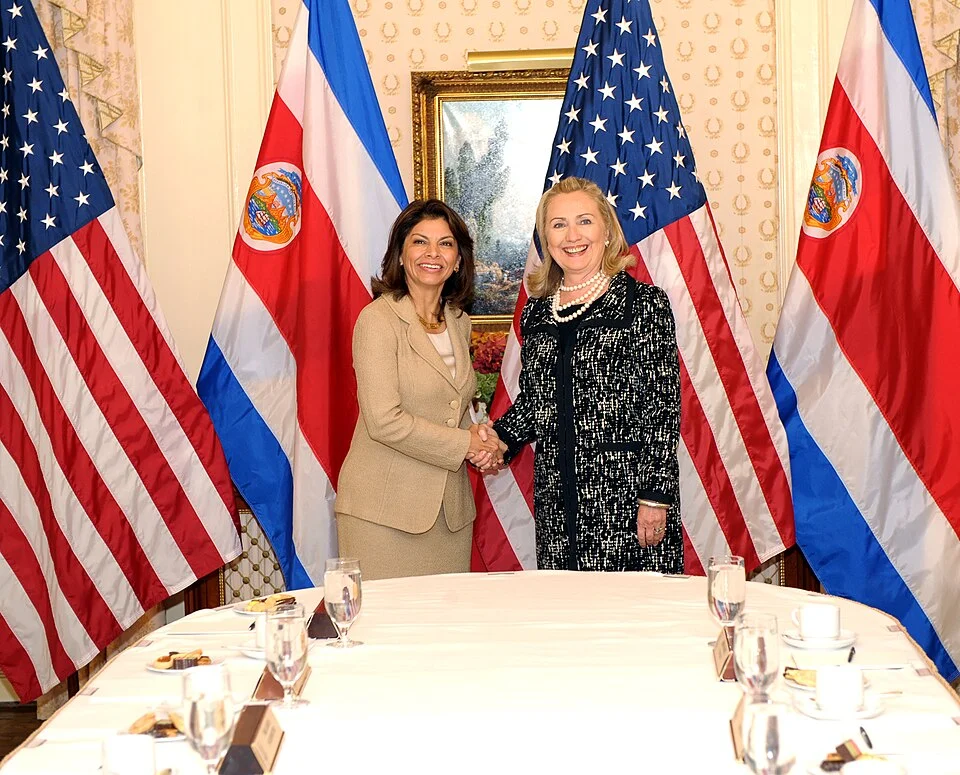
After leaving office in 2014, she taught at Georgetown University in 2016 and went on to become co-chair of the Inter-American Dialogue think tank and vice-president of the Club de Madrid, an organization of former democratic heads of state, positions she has held into the 2020s while remaining a frequent commentator on Central American and broader Latin American political affairs.

Laura Chinchilla
Career Timeline · 1959 – 2026
Born in Desamparados, San José, Costa Rica
B.A. Political Science, University of Costa Rica
M.A. Public Policy, Georgetown University
First woman appointed Vice Minister of Public Security
First woman to serve as Minister of Public Security
Elected to Legislative Assembly; chairs Legal Affairs & Narcotics committees
Vice President under Óscar Arias + Minister of Justice
Elected Costa Rica’s FIRST female president with 46.8% of the vote
Peter Benchley Ocean Award for ocean conservation
Leaves office; teaches at Georgetown (2016); co-chair Inter-American Dialogue, VP Club de Madrid
Leaves PLN party; continues as independent
Assumes Presidency of the Club de Madrid (January 1)
Achievements
- First woman elected President of Costa Rica (2010–2014)
- First woman to serve as Costa Rica’s Minister of Public Security
- Eighth woman elected head of state in Latin American history
- Vice President and Minister of Justice of Costa Rica (2006–2008)
- Peter Benchley “Excellence in National Management of the Ocean” award, 2011
- Co-chair, Inter-American Dialogue
- Vice-President, Club de Madrid
- Guest faculty appointment at Georgetown University’s School of Foreign Service following her presidency
Personal Life
Chinchilla was previously married to Mario Alberto Madrigal Díaz from 1982 to 1985. In 1990, she met Spanish-born lawyer José María Rico Cueto; the couple married in 2000 and had one son together, José María Rico Chinchilla.
Rico served as Costa Rica’s First Gentleman throughout Chinchilla’s presidency, from 2010 to 2014, and remained married to her until his death in April 2019 at age 84. Notably, aspects of Chinchilla’s marital history did not significantly affect her political standing, reflecting a broader culture in Costa Rican politics of avoiding personal attacks on candidates despite the country’s significant Catholic population.
Philanthropy and Public Advocacy
Since leaving the presidency, Chinchilla has focused much of her public advocacy on democratic governance and ocean conservation. Through her roles with the Inter-American Dialogue and the Club de Madrid — a global organization of former democratically elected presidents and prime ministers — she has continued to work on strengthening democratic institutions across Latin America, frequently speaking and writing about the erosion of democratic norms and the rise of authoritarian populism in the region.
Her earlier environmental advocacy as president, particularly around marine protection, has remained a consistent theme in her post-presidential public engagements and writing, and she has continued to be invited to international forums on ocean governance and climate policy well after leaving office.

Controversies
Chinchilla’s presidency faced criticism over slowing economic growth and rising public debt during her term, along with public dissatisfaction over her administration’s handling of several infrastructure and corruption-related controversies inherited from prior administrations.
She left office with relatively low approval ratings by regional standards, though no substantiated personal scandal has been attached to her tenure. Her party, the National Liberation Party, went on to lose the subsequent presidential election in 2014; Chinchilla herself left the party in 2022 and has since identified as an independent, a shift she has attributed to broader disillusionment with traditional party politics in Costa Rica rather than any single incident.
Related: Famous Celebrities in Costa Rica: The Complete List
Influence and Legacy Snapshot
| Category | Contribution |
|---|---|
| National Milestone | First woman elected President of Costa Rica |
| Security Policy | Pioneered women’s leadership in Costa Rica’s public security ministry |
| Regional Representation | Eighth female head of state in Latin American history |
| Environmental Advocacy | International recognition for ocean conservation policy |
| Post-Presidential Role | Global voice for democratic governance through the Club de Madrid |
Legacy
Laura Chinchilla’s 2010 election remains a landmark moment in Costa Rican and Latin American political history, breaking a barrier in a region where women had only recently begun to hold the highest office.
Her earlier career-long focus on public security and judicial reform helped shape Costa Rican institutional policy well before she reached the presidency, and her post-presidential work on democratic governance through the Club de Madrid has kept her engaged in international policy circles years after leaving office. She remains one of the most frequently cited examples of women’s political leadership in Central America.

Beyond the symbolic significance of her election, analysts have also pointed to the way Chinchilla’s rise reflected a broader Costa Rican political culture that, by regional standards, treats gender as less of a barrier to high office than many of its neighbors.
Her career path — moving steadily upward through technical, security-focused roles before reaching the presidency — has also been cited as a model for how expertise-driven political careers can succeed in a country that has historically prized institutional competence over personal charisma in its national leaders.

Conclusion
From a security-focused technocratic career to the presidency of Costa Rica, Laura Chinchilla’s path reflects both personal groundbreaking achievement and sustained policy focus on justice, security, and environmental protection.
Her continued international work through organizations like the Club de Madrid has extended her influence well beyond her four years in Costa Rica’s highest office, and she remains one of Latin America’s most consulted voices on democratic governance and institutional reform.
Next In Your Reading: Óscar Arias Sánchez: Biography, Nobel Peace Prize, Family, and Legacy
Frequently Asked Questions
Was Laura Chinchilla the first female president of Costa Rica?
Yes. She was elected in February 2010 and served from May 2010 to May 2014, becoming the first woman ever to hold Costa Rica’s presidency.
What did Laura Chinchilla do before becoming president?
She served as vice minister and then Minister of Public Security, a member of Costa Rica’s Legislative Assembly, and Vice President and Minister of Justice under President Óscar Arias Sánchez.
Who was Laura Chinchilla’s husband?
She was married to Spanish-born lawyer José María Rico from 2000 until his death in 2019. She was previously married to Mario Alberto Madrigal Díaz from 1982 to 1985.
What has Laura Chinchilla done since leaving the presidency?
She has taught at Georgetown University, and currently serves as co-chair of the Inter-American Dialogue and vice-president of the Club de Madrid, an organization of former democratic heads of state.
What was Laura Chinchilla’s approval rating like as president?
Her administration faced criticism over economic growth and public debt, and she left office with comparatively low approval ratings, though no substantiated personal scandal has been attached to her presidency.